Wednesday, 9 October 2013

Mise en scène

Mise en scène


Mise en scene is a French term meaning what is put into a scene or frame. It is made up of visual information in front of the camera. It communicates essential information to the audience about settings (time & place) and characters.
Mise En Scene is made up of five elements....

Settings & Props:
Settings and locations play an important part in film-making and are not just backgrounds. The sets are either built from scratch or a great deal of time is spent to find a setting with already exists. Settings can manipulate an audience by building certain expectations and then different turns.

Costume, Hair & Make Up:
Costume, Hair and Make up tells us immediately whether the film is set in the present and society/ or culture it will centre around. It also act as an indicator to the audience of character's personality, status & Job. Certain costumes can signify certain individual's. ( E.G black cloak of a vampire) or groups ( E.G. Policeman)

Facial expression & body language:
Facial expressions provide a clear indicator of how someone is feeling. If someone is smiling broadly, We assume they are happy but we may get a different feelings if this is accompanied by scary music. Body language may also indicate how a character feels towards another character or reflect the state of their relationship.


Positioning with character & object within a frame:
Positioning within a frame can draw our attention to an important character/ object. A film-maker can use positioning to indicate relationship between people.


Colour:
Colour carries a certain connotations which may add meaning to a scene. It can give a scene a particular look, feel or mood. It may also be used for dramatic effect. 

Lighting & Colour:
Lighting and colour were used to highlight important characters or objects within the frame. It's also used to make characters look mysterious by shading sections of the face and body. It also used to reflect a character's mental state/ hidden emotion.
~Types of Lightings
      Low key lighting:
*Created by using only the key and back lights.
*Produces sharp contrasts of light and dark areas.
* Deep, distinct shadows/ silhouettes are formed.

~High key lightings
*More filler lights are used.
*Lightings are natural and realistic to our eyes.
*Produces brightly lit sets or a sunny day.


Monday, 7 October 2013

Camera shot types

Camera shot types : 

The camera shots are very important to the video. Good camera shots make the viewer understand more and the movie more interesting.   
The Types of Camera Shots
There are different types of shots.  The names of the shots are based on how much information is included in the shot.


Extreme Wide Shot:
*The view is so far from the subject that s/he isn't even visible. the point of the shot is to show the subject's surroundings.
*The EWS is often used as an ''establishing shot'' - the first shot of a new scene, designed to show the audience where the action is taking place.
*The EWS is also known as an extra long shot or extreme long shot.


Close Up: 
A close up is a shot that focuses heavily on the face or an object, usually blurring out the background to set a deeper focus. This is often used to add emphasis to a scene or an image.


Extreme Close Up:
An extreme-close up is similar to close up, but an extreme close up usually fits the whole frame of a shot, and you can only see a certain feature within the frame, for instance a human feature that focuses on the eyes. this is done to create tension within a scene or image.


Panoramic shot: 
A Panoramic shot is a serious of landscape photographs that have been put together by software, but taken individually, then overlapped to create a wide panoramic shot. Particularly used to show an overview of scene.


Long Shot: A long shot shows a realistic scale of an object or human being. It is able to fit objects and people within a scene in the frame without cutting anything out. It is also able to if necessary, show other happenings/ People in the background.


Extreme Long Shot:
An extreme long shot is used to the scene and mood of a film. It is typically used in action adventure scenes, to create tension. Although little detail is paid to the image. You are able to establish where the scene has been set.


Middle Shot:


Middle shot is where the camera focuses on a figure from the waist upwards, or an object with little zoom. The middle shot outlines the characters and the background has little detail, very minimal and usually blurry.


Birds Eye View:
Birds eye view shows a 'summary' of a scene, this is taken in the view high above ground level, people and objects are smaller than actual size when this camera effect is used but it is good way to show an overall perspective of a scene. It is typically used in action films when a new location is introduced.


High Angle Shot:


A high angle shot is similar to a bird eye view, but instead of using a helicopter to get an overview of the scene, a crane is used to elevate
the camera, and the focus on filming on something at ground level.


Low Angle Shot: 
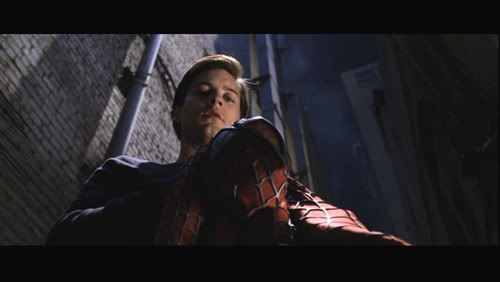
Low angle shots are filmed at ground level and are used commonly when filming action scenes. This adds the effects of anxiousness for the character on screen, and fear, because the effect is used to build up tension from scene. this type of shot would be used for example when; a character has to jump from one building to another, or from one building to the ground.


Point Of View Shot: 
Point of view shots are the shots in the perspective of a character within the film, It is as if the audience are experiencing everything the character goes through within that scene. it is the technique used to make the audience feel like their part of the films, and actually are the main character. It is used to show the audience the perspective of the main character and works well in most films. It is typically used so that the audience can engage with the film and it's characters.


Oblique:
Oblique is the term used for camera shots that are titled slightly at an angle to show confusion or disturbance within a film. It is a good way to introduce disaster scenes, such as weather effects. Oblique shots are most popular with horror films, Oblique shots are similar to point of view shots because there is an eventual transition where the camera becomes the view of a character within the film.


Over The Shoulder Shot:
Over the head shoulder shots are used to show the perspective of a character, as if they are being watched or followed by somebody. The purpose of this type shot is to engage the audience as if they are in the presence of the character.


Two Shot:
A comfortable shot or two people often used in interviews, or when two presenters are hosting the show.


Noddy shot:
This is a shot of the person listening and reacting to the subject.


Tracking:
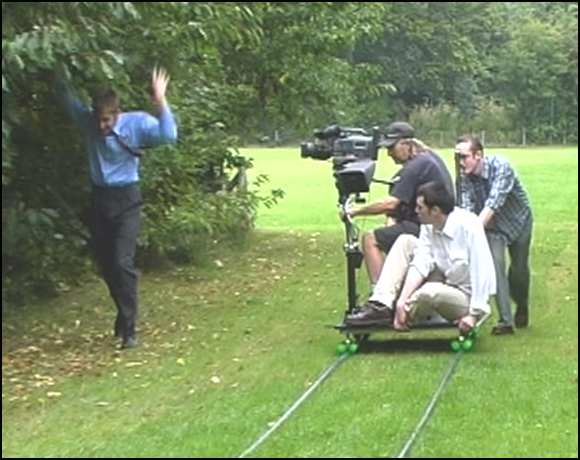
Tracking is when the camera is on a track or with a dolly, or on a cable and follows the action of a shot it is most commonly used to explore a room such as a restaurant. By using a tracking shot or a dolly shot the composer of a film gives the viewer a detailed tour of a situation. It can also be used to follow a character.


Arc (left/ Right)- 
Moving the camera in a curved motion around the set while the camera stays fixed on an object or character. 
•You can arc right or arc left

Dolly (in/ Our)-

Physically moving the camera, it's tri-pod, and dolly towards or away from the set.
•You can dolly in or dolly out


Truck (left/ right)-
             Physically moving the camera, it's tri-pod, and      dolly left or right parallel to the set.
                 •You can Truck right or Truck left

Pedestal (up / down)- 
Raising or lowering the camera on the tripods pedestal while the tripod remains stationary.
•You can Pedestal up or down

Tilt- 
Positioned on a horizontal axis and the camera rotates up and down or down and up.

Inserts – 
A full screen shot of descriptive information that helps to clarify a scene. i.e.. - full screen shots of letters, clock faces, cannon fuses.
Choker – 
Is from just above the eyebrow to just below their chin. Used in an exclamatory way, to show the expression of a face or to simply show a persons face to help identify a character.

Steady Can: 
It is used to achieve a smooth even shot when shooting action. It is probably achieved by using a dolly and tracks. Steadicam helps keep the camera work invisible to the audience so they just focus on the action.

Hand held Camera: 
It's when the cinematographer is just holding the camera. this creates a shaky effect. It maybe used to draw the audience into the action or to see the action from the character's perspective.

Steadicam - a damped suspension camera which removes jerkiness when moving. This tends to be worn by an operator and tends to follow the characters when they move or when they are in action.

Wednesday, 18 September 2013

Action/Adventure films ( Summer Homework )


Action Adventure Films Audience Appeal


The special effects (explosions, crashes, characters, monsters etc)
Action Adventure films are known for their breath taking special effects. As technology has developed, special effects have become bigger and better. Modern films can use Computer Generated Images (CGI) to create amazing special effects.


The main hero (stereotypically athletic, handsome, sexist, tough)
Male audiences generally idolise the heroes of Action Adventure films. Males used the heroes as role models; they wanted to be like them!


Beautiful leading ladies
This is one thing that has changed. Leading ladies used to be in the film to look good and be rescued by the Action Adventure film hero. However, in most modern films the leading lady has improved her role and is a much stronger character. In fact in some recent films the Action Adventure hero is female!


Exotic, far away locations
Action Adventure films shoot scenes in some exotic or far away locations that most people would have never visited. This makes the films more attractive as the audiences can see countries that they will never probably see in real life.


Evil villains
You can only judge a hero by the villain they have to defeat. The greater the villain, the more impressive the Action Adventure hero. So, an impressive villain is important to Action Adventure films.


Action scenes (car chases, races, battles)
Action Scenes are important to an Action Adventure film audience. They are usually the scenes that audiences enjoy the most as they create the most excitement. Action scenes are what audiences associate with watching Action Adventure films.